A Faraday cup is a metal cup designed to catch charged particles in vacuum. When a beam or packet of ions hits the metal it gains a small net charge while the ions are neutralized.
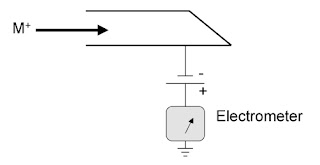
The metal can then be discharged to measure a small current equivalent to the number of impinging ions. By measuring the electrical current by electrometer in the metal part of the circuit, the number of charges being carried by the ions in the vacuum part of the circuit can be determined by using this expression.

The metal can then be discharged to measure a small current equivalent to the number of impinging ions. By measuring the electrical current by electrometer in the metal part of the circuit, the number of charges being carried by the ions in the vacuum part of the circuit can be determined by using this expression.
N/t = I/e
Where
N = Number of ions observedt = time taken in seconds
I = Measured Current (in amperes)
e = charge of electron (about 1.60 × 10⁻¹⁹ C).
Faraday cups are not as sensitive as electron multiplier detectors, but are highly regarded for accuracy because of the direct relation between the measured current and number of ions.
